

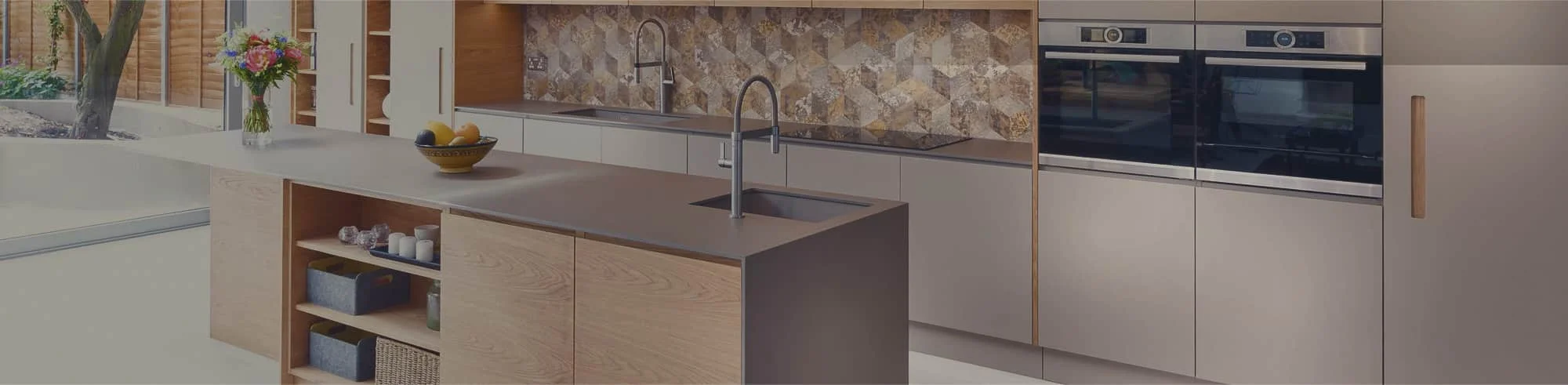
A granite slab may look beautiful alone but too busy beside cabinets and backsplash. If you are choosing granite kitchen countertops for a GTA renovation, ask: “Will I like this pattern across the whole kitchen?”
Quick answer: To keep granite from overwhelming your kitchen, judge the pattern from a distance, compare it with real cabinet and backsplash samples, check the colours under your actual lighting and review the planned slab cuts before fabrication. These seven checks help you make that decision before you buy.
1. Step Back: Does the Pattern Look Calm From Across the Room?
A small sample may hide the full movement of a slab. Stand several steps away from a large section. What catches your eye: one bold streak, scattered marks or an even pattern?
Try this: Look at the stone from roughly the distance between your kitchen entrance and countertop. If every section demands attention, decide whether the stone should be the room’s main feature.
2. Put a Full Cabinet Door Beside the Stone
Compare the granite with an actual cabinet door, not just a paint chip. A smooth Shaker door looks different beside stone than a strongly grained door.
Try this: Place the door beside a large stone sample. View them together from nearby and a few steps back. Compare white and cream undertones, or check whether wood grain competes with stone movement. If both feel bold, simplify one.
For a deeper guide to colours, read CGD’s granite and cabinet colour matching guide.
3. Test Backsplash Tile and Grout Together
Tile and grout can introduce another pattern. White tile with dark grout creates a strong grid; closer-matching grout usually looks quieter.
Try this: Arrange several tiles in a small section beside the granite and cabinet sample. Include the grout colour you intend to use. If the granite has strong movement, start with a plain or subtly textured tile. Add a patterned backsplash only after checking the entire combination, not just one tile.
4. Check the Stone in Daylight and Under Kitchen Lights
Daylight, overhead fixtures and under-cabinet lights can change how stone colours and contrast appear.
Try this: If samples can be taken home, compare them near a window during the day and under your normal lights after dark. Look at the cabinet door, granite and backsplash together. Photos can help you remember the overall layout, but use your eyes for the final colour decision.
5. Picture the Countertop With Everyday Kitchen Items
A working countertop holds kettles, chopping boards and other items. Natural movement may feel different around them.
Try this: In your existing kitchen, note what normally stays on display and where it sits. Compare that area with a photograph of the full granite slab or a realistic design mock-up. If your space already has many visible appliances, you may prefer a calmer stone pattern or simpler surrounding finishes.
6. Ask Where the Strongest Patterns and Seams Will Land
The section you admire in a full slab may not be the section installed beside your sink or across your island. Cutouts and seams determine which patterns appear together; adjacent pieces may not align perfectly.
Try this: Before fabrication, ask whether you can review the actual slab selection and proposed cut layout with the fabricator. Point out any area you especially like or want to avoid. Some seam locations or pattern arrangements may not be practical, and special layout requests can affect material use and cost. Confirm what can be accommodated before approving the work.
7. Do a Final Whole-Kitchen Check, Not Just a Countertop Check
Flooring, walls, hardware and islands also add detail. Bold granite usually benefits from quieter surrounding surfaces.
Try this: Put all your finish samples on one table. Stand back and identify the first thing you notice. If the floor, cabinet grain and granite all compete, choose which feature matters most and simplify a supporting finish. This is a design preference test, not a fixed rule.
Sample Cabinet, Granite and Backsplash Combinations to Test
These are illustrative starting points, not guaranteed matches. CGD lists granite names including Bianco Antico, Giallo Ornamental, Alaska White and Ice Blue. Natural appearance can vary by slab, and availability must be confirmed with the showroom.
| Cabinet finish | Granite to compare | Backsplash starting point | What to test |
|---|---|---|---|
| White Shaker | Bianco Antico | Plain off-white tile, quiet grout | Do the light tones work together? |
| Warm wood grain | Giallo Ornamental | Simple matte neutral tile | Does the wood grain compete with the slab? |
| Espresso or dark brown | Alaska White | Subtle light tile | Is the overall light-dark contrast comfortable? |
| Grey slab-front | Ice Blue | Low-pattern neutral tile | How does the combination look at night? |
Use the CGD countertop selection page to start exploring granite options, then confirm colours against physical samples rather than product names alone.
Before You Order: A Five-Minute Pattern Checklist
- Have I seen the largest available view of the granite pattern?
- Have I compared a real cabinet door and a backsplash-and-grout sample?
- Have I checked the combination in daylight and evening light?
- Have I considered the floor, appliances and other visible finishes?
- Have I discussed the actual slab, cut layout and seam expectations with the fabricator?
Compare Granite and Cabinet Finishes at a CGD Showroom
If you are renovating in Toronto or the GTA, bring your cabinet colour, flooring photo and backsplash ideas when you compare countertop options. Cabinets & Granite Direct has showroom locations in Markham, Mississauga and Vaughan. Ask about the granite samples currently available and what options can be reviewed for your project.
Explore CGD granite countertops or contact CGD to plan a showroom visit. You can also read how to design cabinets around granite if you are still deciding on your cabinet style.
Frequently Asked Questions About Granite Countertop Patterns
How can I tell whether a granite countertop pattern is too busy?
View the largest available section from several steps away, then place cabinet and backsplash samples beside it. If several surfaces compete for attention, try quieting one of them before choosing the final combination.
Do I need to see the actual granite slab before ordering?
Whenever practical, yes. Granite is natural stone, so pattern placement and grain density can vary between slabs. Ask your supplier which piece will be used and whether you can review it before fabrication.
Can patterned granite work with wood-grain cabinets?
Yes. Compare the size and contrast of the wood grain with the granite pattern. A calmer grain, simpler cabinet door or quieter backsplash may help the materials work together.
What backsplash and grout should I try with strongly patterned granite?
Start with a simple tile and grout that is close in colour to the tile. This reduces the visible grid and lets the granite be the stronger pattern. Test a group of tiles rather than a single piece.
Can seams change how a granite pattern looks after installation?
Yes. A cut can separate a prominent streak or place two areas of different movement beside each other. Ask the fabricator to explain the proposed layout and seam locations before fabrication.