

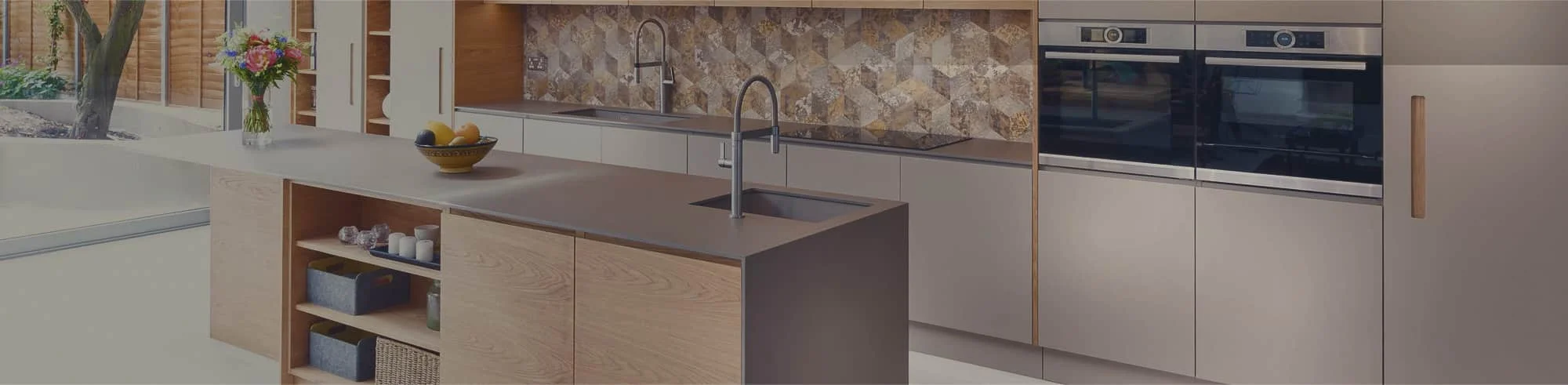
You can choose beautiful cabinets and a beautiful granite slab and still end up with a kitchen that feels slightly off.
The problem is usually not either material on its own. It is how the cabinet colour, granite pattern, island, backsplash, countertop edge and lighting work together. That “assembled from three different showrooms” feeling is one of the most common complaints homeowners raise once a granite kitchen is installed — and it is almost always fixable at the planning stage.
Start With the Actual Granite, Not Just a Photo
Granite is a natural stone, so colour, mineral pattern and movement can vary from one slab to another. That variation is part of what gives granite its character, but it also means a small online image should not make the final design decision for you.
If possible, compare your cabinet door, flooring and backsplash samples with the actual slab you are considering.
Look at three things:
- Background colour: Is the slab mainly white, cream, grey, brown, black or another tone?
- Undertone: Does it lean warmer, cooler or relatively neutral?
- Pattern strength: Is the movement quiet and consistent, or large and dramatic?
These details tell you much more than simply calling a granite countertop “white” or “grey.”
If cabinet colour is your main concern, see our more detailed guide on matching granite kitchen countertops with cabinet colours. For the rest of the kitchen, keep reading.
Decide Which Surface Should Lead the Kitchen
A useful design rule is to choose a visual lead.
If your granite has large veins, strong contrast or several noticeable colours, it can naturally become that lead. In that case, simple cabinet finishes and a quieter backsplash give the stone room to breathe.
If the granite has softer movement, the cabinets can take on more personality. A deeper island colour, more detailed door style or stronger backsplash can work because the countertop is not fighting for the same attention.
This does not mean everything has to match. It means every finish needs a job.
- One element can lead.
- One or two can support it.
- The remaining finishes should connect the room rather than compete with it.
That is usually what makes a kitchen feel intentional instead of assembled one sample at a time.
Choose Cabinet Colour to Support the Granite
When choosing kitchen cabinets, do not search for a cabinet colour that matches every colour inside the granite. You only need a clear relationship between the two materials.
For granite with strong movement
Start with the quieter colours already present in the slab. A simple cabinet finish can balance a countertop with dramatic mineral patterns without hiding what makes the stone interesting.
For quieter granite
You have more flexibility. Similar cabinet and countertop tones can create a softer look, while a stronger light-to-dark contrast can make the countertop outline more noticeable.
For warm or cool combinations
Pay attention to undertones rather than the colour name on the sample. Two surfaces described as “white,” for example, can feel very different beside each other if one is noticeably warm and the other cool.
Whenever possible, put the actual samples beside each other before approving the combination.
Let the Countertop Edge Fit the Cabinet Style
The countertop edge is a small detail, but you see it across the entire perimeter of the kitchen.
A simpler edge tends to create a cleaner visual line. This usually works well when the cabinets have simple profiles or when the granite itself already has plenty of movement.
A more rounded or decorative profile introduces more detail. That can make sense in a kitchen where the cabinet doors, mouldings and other finishes also have a more traditional character.
The goal is not to find one edge profile that is “best” for granite. The better question is: does the edge reinforce the design language already happening in the cabinets?
Also discuss the selected edge with your fabricator before finalizing the countertop. Stone characteristics, slab thickness and fabrication requirements can affect what is appropriate for a specific project.
Use the Kitchen Island as a Bridge, Not a Separate Design
The island is where many kitchens become unnecessarily complicated.
A different island cabinet colour can work well, but contrast needs a reason. Instead of choosing an island finish in isolation, pull it back to something already visible in the granite or elsewhere in the kitchen.
For example, if the granite contains darker grey or brown mineral movement, a deeper island finish may visually connect to those tones. If the perimeter cabinets are already dark, a lighter island can create separation without introducing another unrelated colour.
If you prefer a quieter room, using the same cabinet finish on the island and perimeter is also completely valid.
Matching is not boring. Contrast is not automatically better. The right choice is the one that makes the countertop, cabinets and island read as one kitchen.
Keep the Backsplash From Competing With Busy Granite
A countertop and backsplash sit directly beside each other, so competing patterns become obvious quickly.
If your granite kitchen countertops already have noticeable veining, speckles or colour changes, start by testing a quieter backsplash. This gives the eye somewhere to rest.
If your granite is relatively restrained, you have more freedom to consider texture, pattern or stronger contrast on the wall.
A useful question is: if I look at the finished kitchen from the doorway, what do I want to notice first?
If the answer is the granite, the backsplash probably does not need to make the same statement.
Bring backsplash samples beside the granite and cabinet door rather than judging each product separately. A sample can look perfect on its own and still be wrong for the full combination.
Check Granite Under the Lighting You Will Actually Use
Lighting affects how we perceive colour. A granite sample can appear warmer, cooler, lighter or more muted depending on the light source around it. The same applies to cabinet finishes.
That is why a combination that looks right under showroom lights may look somewhat different beside your kitchen window or under your evening lighting.
Before you finalize the finishes, check samples in more than one condition:
- Natural daylight in the kitchen
- Your main ceiling lighting
- Under-cabinet lighting, if you plan to use it
- Evening lighting when daylight is no longer affecting the room
You do not need to become a lighting expert. You just want to avoid making a colour decision under one light source and assuming it will look exactly the same everywhere.
Quick Reference: Bold Granite vs. Quiet Granite
Use this table as a starting point, then confirm against your actual samples.
| Design Element | If Your Granite Has Bold, Busy Movement | If Your Granite Has Soft, Quiet Movement |
|---|---|---|
| Cabinet colour | Simple finish drawn from the slab’s quietest tone | More freedom for deeper colour or a detailed door style |
| Backsplash | Quiet, low-pattern tile | More room for texture, pattern or stronger contrast |
| Kitchen island | Match the perimeter, or use a tone pulled from the granite’s darkest veining | Bolder contrast colour, tied back to the floor or another finish |
| Countertop edge | Simple, clean profile (e.g., eased or bevel) | More decorative profile if the cabinet style is traditional |
Common Mistakes That Make a Granite Kitchen Look Mismatched
Most “mismatched” kitchens are not the result of bad materials. They come from a handful of predictable decision-making mistakes:
- Hunting for a cabinet that matches every fleck in the granite. Natural stone will never match a cabinet swatch grain-for-grain, and chasing an exact match usually leads to a flatter, less interesting result than working with the undertone instead.
- Choosing the island colour in isolation. A striking island finish picked on its own, without checking it against the granite or perimeter cabinets, is the single most common source of a “thrown together” look.
- Pairing busy granite with a busy backsplash. Two dominant patterns sitting directly beside each other compete for attention instead of supporting one another.
- Approving samples under one light source only. A combination that looks perfect under showroom lighting can shift noticeably under daylight or evening lighting at home.
- Treating the edge profile as an afterthought. Because it runs the entire perimeter of the counter, an edge that clashes with the cabinet style is visible everywhere, not just in one spot.
- Assuming same-named colours will match. Two “white” or “grey” finishes can still clash if one leans warm and the other leans cool.
For a Fall Kitchen Project, Use Late Summer to Compare the Full Palette
If you are planning a fall renovation, late August is a useful point to stop collecting separate inspiration photos and start comparing the materials together.
Put the cabinet door, granite, backsplash and flooring samples in one group. Then remove anything that feels unrelated.
This is often more useful than adding another colour to “fix” a combination that already has too much happening.
You can also use CGD’s Virtual Kitchen Design tools to experiment with countertop, cabinet and backsplash combinations before finalizing your choices.
A Simple Checklist Before You Approve the Kitchen
Before signing off on the materials, ask yourself:
- What is the main visual feature of the kitchen?
- Do the cabinet undertones work with the granite?
- Does the island connect to the rest of the room?
- Are the countertop and backsplash competing for attention?
- Does the edge profile fit the cabinet style?
- Have I looked at the samples under my actual kitchen lighting?
- Does the entire combination still work when I look at it together instead of one product at a time?
If those answers are clear, you are much less likely to end up trying to solve a mismatched kitchen after installation.
Design the Kitchen as One Room
Good kitchen design is not about finding the granite that matches your cabinets perfectly. It is about creating enough connection between the surfaces that the finished room feels considered.
Start with the granite. Understand its colour and pattern strength. Decide whether it should lead or support the room. Then use the cabinets, island, edge profile, backsplash and lighting to build around that decision.
For homeowners planning a renovation in Markham, Mississauga, Vaughan or the GTA, Cabinets & Granite Direct offers granite countertops, kitchen cabinetry and design support to help you compare the complete kitchen rather than choosing each finish separately.
Want to see how your cabinet and countertop choices work together? Bring your ideas and measurements to CGD and compare your options before making the final decision.
Frequently Asked Questions About Granite Kitchen Countertops and Cabinets
What cabinet colours go best with granite kitchen countertops?
There is no single cabinet colour that works with every granite slab. Start with the granite’s background colour, undertone and pattern strength. Cabinets can either stay close to those tones for a softer look or provide controlled contrast. The important part is making sure the undertones do not clash.
Should the kitchen island match the perimeter cabinets?
No. The island can match the perimeter cabinets for a consistent look or use a different finish for contrast. If you use a second cabinet colour, connect it to a tone already present in the granite, flooring or another major kitchen finish so the contrast feels intentional.
What backsplash works with a busy granite countertop?
A quieter backsplash is often easier to coordinate with strongly patterned granite because it avoids putting two dominant surfaces directly beside each other. If the granite has restrained movement, you may have more flexibility to introduce pattern or texture on the backsplash.
Which countertop edge looks best with granite?
The right edge depends on the overall kitchen style and the specific stone. Simple profiles can support clean or contemporary cabinet designs, while more detailed profiles can suit kitchens with more traditional detailing. Confirm the final edge with your countertop fabricator because fabrication requirements vary by project.
Can kitchen lighting change how granite looks?
Yes. Different light sources can affect how colours and undertones appear. Compare your granite and cabinet samples under natural daylight and the artificial lighting you expect to use in the finished kitchen before making the final colour decision.
Should I choose cabinets or granite countertops first?
Either can come first, but one should become the design anchor. If you already love a distinctive granite slab, build the cabinet palette around it. If the cabinet colour or style is already fixed, look for granite that supports that choice. What matters most is comparing the materials together before ordering.
How do I keep a granite kitchen from looking mismatched?
Pick one surface to lead the design instead of treating cabinets, granite, island, backsplash and lighting as separate decisions. Bold, high-movement granite usually works best as the lead, with quieter cabinets and backsplash supporting it; quieter granite gives you more room to add contrast elsewhere. Then check every finish against the granite’s undertone, and view your samples under your kitchen’s actual lighting before approving them.